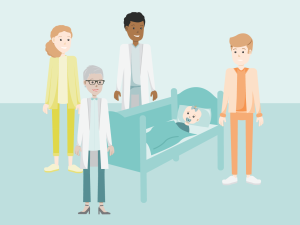
 Throughout your journey, your care team is there to support and guide you, as well as answer any questions or concerns you have.
Before your surgery, doctors called anesthesiologists will visit you. They are responsible for keeping you asleep during surgery. You will not feel any pain while you are asleep. All you will remember is traveling down to the operating room.
Your Surgery Day
The surgeon performs a sternotomy which involved opening your chest and implanting the cannulae into your heart. This will leave a scar on your chest. During the surgery, you will be on a heart and lung bypass machine, which helps circulate your blood during the operation.
After the VAD is turned on, the settings are adjusted to provide the correct blood flow to your body.
 When you wake up from surgery, you will be in the Intensive Care Unit (ICU).
Surgery will make you feel weak and sleepy. For these reasons, you will have a plastic tube in your mouth that will help you breathe. You will also have many special IVs, cables, and drains, which are needed to monitor your VAD and heart function.
This medical equipment is necessary to monitor you and give you the medicines needed for recovery. All the equipment and lines can be startling to see, but they are completely normal. Day by day, your care team will work toward removing lines and tubes. It is also important to get you moving soon after surgery. Getting out of bed as soon as possible will help your body heal.
As with any surgery, you will probably feel some pain afterwards. Once your care team thinks you’re strong enough to be more awake and breathe on your own, your medicines keeping you sleepy will be turned off. Your breathing tube will be removed, and you will be given oxygen using a nasal cannula or mask. Your care team may also decide to give you a boost of nutrition, feeding you through a special tube in your nose called a nasogastric tube.

The Berlin Heart helps patients with heart failure, as it improves blood circulation. A Berlin Heart may help reduce heart failure symptoms and improve quality of life while waiting for a heart transplant or your heart to get better.
 There are some risks with a Berlin Heart, but your care team will work hard to keep you safe.
Infection
The soft cannula will come out of your lower chest and will need to be cleaned frequently. This is important because bacteria lives on your skin and may cause an infection at your cannula site. You may feel nervous the first few times your dressings are changed, but your care team will be there to support you.
Stroke
There is a risk of stroke with all VADs. A clot can form in the VAD, become dislodged, and may travel up a blood vessel to the brain. A blood clot in the brain leads to a decreased blood flow to the brain in that specific area, and this is called a stroke. Your care team will manage your blood thinner medicines and levels carefully to try to prevent a stroke. Sometimes, even with perfect levels, a stroke will occur.
Your care team will monitor you for the following symptoms:
- Headache
- Confusion
- Numbness and/or tingling on one side of the body
- Weakness on one side of the body
- Slurred speech
Bleeding
There is a risk of bleeding with all VADs. To prevent clots from forming in the device, you have to be on a blood thinner. Sometimes the blood thinner will lead to bleeding that may require a change in medicines, a blood transfusion, or in some cases, a surgery to stop the bleeding. Your care team will manage your blood thinner medicine and levels carefully to try to prevent bleeding. Sometimes, even with perfect levels bleeding will occur.